Welding Blankets Price Guide: What to Expect & How to Get the Best Value
Welding blankets price varies more than most buyers expect — and the difference between a $20 blanket and a $120 one isn't just marketing. With demand for fire-rated protective equipment rising across construction, shipbuilding, and industrial maintenance, understanding what drives pricing has become essential for anyone making a purchasing decision.
So what does a welding blanket actually cost in today's market? Here's the short answer:
- DIY & hobbyist welders: $15–$35 for a standard fiberglass blanket
- Professional shop & contractors: $35–$80 for silicone-coated or carbon felt options
- Industrial & regulated environments: $80–$150+ for high silica or ceramic fiber blankets
As raw material costs and safety compliance requirements continue to shift, buyers who understand what they're paying for make better decisions — and avoid costly replacements down the line.
This guide covers everything that affects welding blanket pricing — material, size, coating, and certification — so you can choose with confidence. Read on to find the right blanket for your budget and application.
Table of Contents
- How Much Do Welding Blankets Cost?
- What Affects the Price of a Welding Blanket?
- Welding Blanket Price by Material — Which Is Worth the Money?
- Welding Fire Blanket Price: What's the Difference?
- Welding Blanket Price by Size
- Where to Buy Welding Blankets at the Best Price
- Are Cheap Welding Blankets Worth It?
- FAQs About Welding Blanket Pricing
How Much Do Welding Blankets Cost?
_1781590912_WNo_1600d900.webp)
Short answer: anywhere from $15 to over $150 — depending on material, size, and intended use.
A hobbyist doing occasional MIG work at home needs something very different from a shipyard crew running 10-hour shifts with open-arc welding. The price gap reflects that reality.
Welding Blanket Price at a Glance
Here's what you'll typically pay across the three main tiers:
| Tier | Typical Price Range | Common Material | Best For |
|---|---|---|---|
| Entry-Level | $15 – $35 | Fiberglass | DIY, light hobby welding |
| Mid-Range | $35 – $80 | Silicone-coated fiberglass, carbon felt | Workshop use, general contractors |
| Heavy-Duty | $80 – $150+ | High silica, ceramic fiber | Industrial, shipyard, pipeline work |
Size is the other big variable. A 4×6 ft blanket typically costs 30–40% less than a 6×8 ft version made from the same material.
Entry-Level: $15 – $35
This is your standard fiberglass welding blanket. A weekend welder laying down a few beads in the garage? A $20 fiberglass blanket covers the floor, catches the sparks, and gets the job done.
- Rated up to 1022°F (550°C)
- Lightweight, foldable, easy to store
- Common sizes: 4×6 ft, 6×8 ft
- Fiberglass can irritate skin — wear gloves when handling
Real example: A 4×6 ft fiberglass welding blanket on Amazon typically runs $15–$25. Buy a 2-pack and you're often looking at $25–$35 total — less than $15 per blanket.
Mid-Range: $35 – $80
Silicone-coated fiberglass and carbon felt blankets live here. Picture a fabrication shop running daily cutting and grinding — the crew needs blankets that survive repeated use without shedding or falling apart after a month.
- Silicone-coated: rated up to 1800°F (982°C), more resistant to spatter and abrasion
- Carbon felt: rated up to 1800°F, softer texture, no skin irritation
- Heavier build means better draping around equipment
A silicone-coated 4×6 ft blanket runs around $35–$55. A carbon felt version of the same size sits closer to $45–$70.
Heavy-Duty: $80 – $150+
High silica and ceramic fiber blankets are built for extreme environments. Think pipeline welders preheating thick-wall pipe at 400°F ambient — standard blankets would scorch within minutes. These don't.
- Rated from 2000°F up to 2300°F+ (1093–1260°C)
- Minimal thermal shrinkage after repeated heat cycles
- Common in shipyard, petrochemical, and pipeline applications
Worth knowing: A ceramic fiber blanket at $120 often outlasts five $25 fiberglass blankets in heavy industrial use. Over a year, the "cheaper" option can cost significantly more.
If your work doesn't regularly exceed 1500°F, heavy-duty blankets are likely overkill — and unnecessary spend.
What Affects the Price of a Welding Blanket?
Two blankets, same size — one costs $20, the other $90. Here's what's actually driving that gap.
Material
The biggest price driver. Fiberglass is the cheapest to produce. Silica, carbon fiber, and ceramic require more refined manufacturing — and cost more as a result. More on this in the next section.
Size
Larger blankets use more raw material. Simple as that. A 6×8 ft blanket typically costs 30–50% more than a 4×6 ft version in the same material.
Thickness & Weight
Measured in GSM (grams per square meter) or oz/yd². A 550 GSM fiberglass blanket and an 850 GSM version may look identical — but the heavier one handles more heat cycles before degrading.
- Light duty: 400–600 GSM
- Standard: 700–900 GSM
- Heavy duty: 900 GSM+
Surface Coating
A silicone or neoprene coating adds $15–$30 to the base price of a fiberglass blanket. That coating buys you better spatter resistance, easier cleaning, and less skin irritation — often worth it for daily shop use.
Certifications & Standards
Blankets rated to NFPA 701, EN 1869, or FM-approved standards carry a price premium. For hot work permits in regulated environments — refineries, offshore platforms — these aren't optional.
Welding Blanket Price by Material — Which Is Worth the Money?
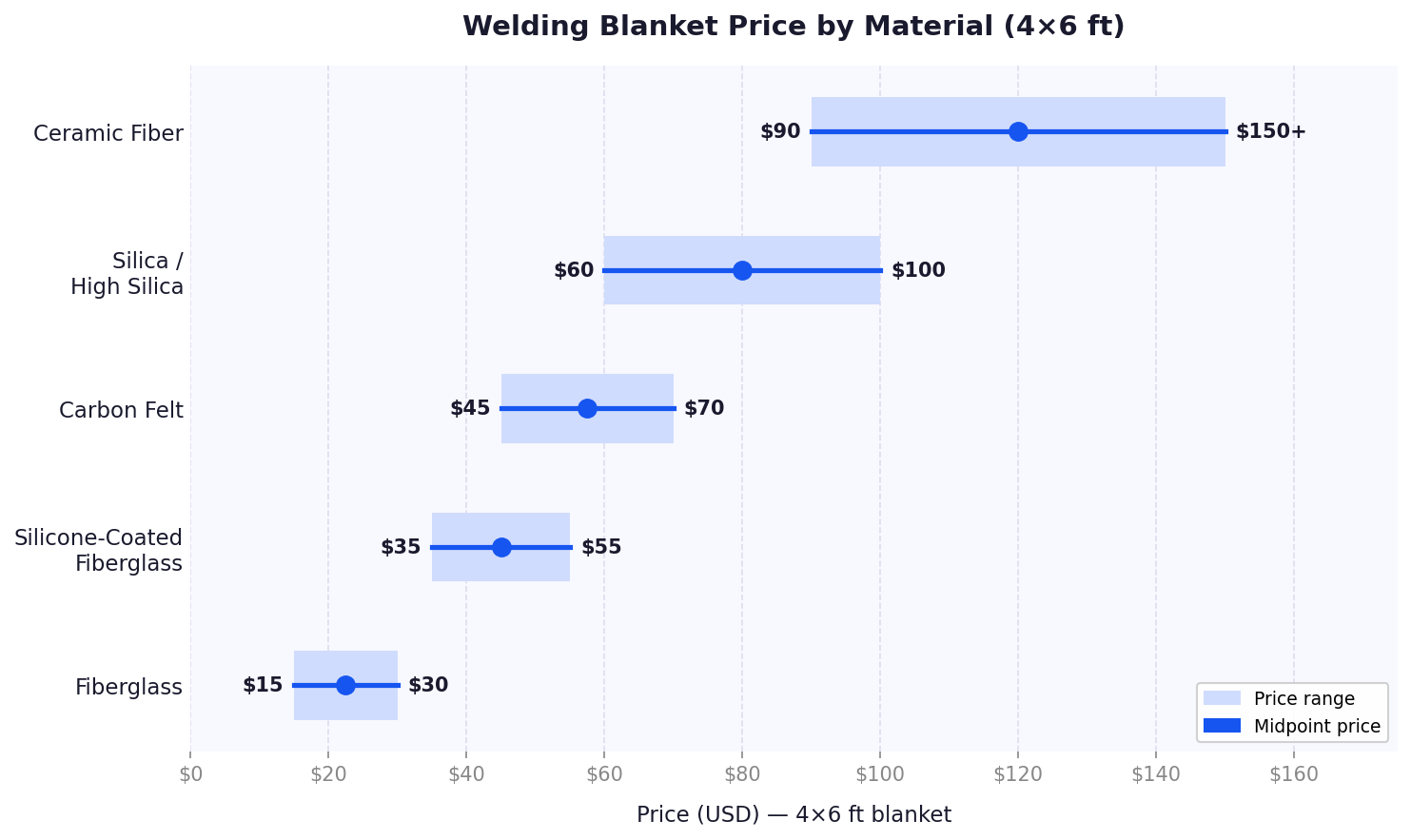
Material choice drives both cost and performance. Here's how the main options stack up:
| Material | Price Range (4×6 ft) | Max Temp | Best For | Value Rating |
|---|---|---|---|---|
| Fiberglass | $15 – $30 | 1022°F (550°C) | DIY, light shop use | ★★★★☆ |
| Silicone-Coated Fiberglass | $35 – $55 | 1800°F (982°C) | General professional use | ★★★★★ |
| Carbon Felt | $45 – $70 | 1800°F (982°C) | Frequent use, skin-sensitive users | ★★★★☆ |
| Silica / High Silica | $60 – $100 | 1800°F – 2000°F | Heavy industrial, hot work permits | ★★★★☆ |
| Ceramic Fiber | $90 – $150+ | 2300°F+ (1260°C+) | Shipyard, pipeline, extreme heat | ★★★☆☆ |
Value rating reflects cost-to-performance ratio for typical users — not absolute quality.
Fiberglass: Best Budget Pick
At $15–$30 for a 4×6 ft, fiberglass blankets are the default choice for occasional welders. They do the job — but the fibers can irritate skin, and they don't hold up well under daily heavy-spark exposure.
Best for: Home garage welding, grilling protection, one-off repair jobs. Not ideal for professional daily use.
Silicone-Coated Fiberglass: Best All-Rounder
This is the sweet spot for most professional welders. The silicone layer blocks spatter, resists abrasion, and eliminates the itchy-skin problem of bare fiberglass. At $35–$55 for a 4×6 ft, it's the upgrade most shops should make.
Carbon Felt: Best for Comfort & Repeat Use
Carbon felt is soft, flexible, and rated to 1800°F. No fiberglass irritation. Welders who handle blankets bare-handed every day often prefer this. Slightly pricier than silicone-coated, but easier to work with.
Silica & High Silica: Best for Regulated Environments
Silica blankets are the go-to for hot work permits and industrial compliance. Rated up to 2000°F, they're standard on construction sites and refineries where NFPA requirements apply. Expect to pay $60–$100 for a 4×6 ft.
Ceramic Fiber: Best for Extreme Heat
Ceramic blankets can handle 2300°F+. A pipeline crew preheating thick-wall pipe doesn't have another option at this temperature range. But for anything under 1800°F, ceramic is overkill — and you're paying a premium for capability you won't use.
Welding Fire Blanket Price: What's the Difference?
You'll often see welding fire blanket and fire blanket for welding listed as separate products — and the price difference can be confusing if you don't know what you're actually comparing.
A standard welding blanket protects against sparks and spatter. A welding fire blanket is rated for flame containment and fire suppression — built to stricter standards for regulated hot work environments.
Price Range Comparison
| Type | Price Range | Typical Use |
|---|---|---|
| Standard welding blanket | $15 – $50 | DIY, general shop use |
| Welding fire blanket (silicone-coated / silica) | $40 – $100 | Contractor, hot work environments |
| Certified fire blanket for welding (industrial) | $80 – $150+ | Regulated sites, hot work permits |
The price gap is real — but so is the risk of using the wrong type on a regulated job site.
Key point: If your work requires a hot work permit, you likely need a certified fire blanket for welding — not just a standard welding blanket. Check your site's safety requirements before buying.
For most contractor and workshop use, a silicone-coated or high silica welding fire blanket in the $50–$90 range covers both spark protection and fire containment needs.
Welding Blanket Price by Size
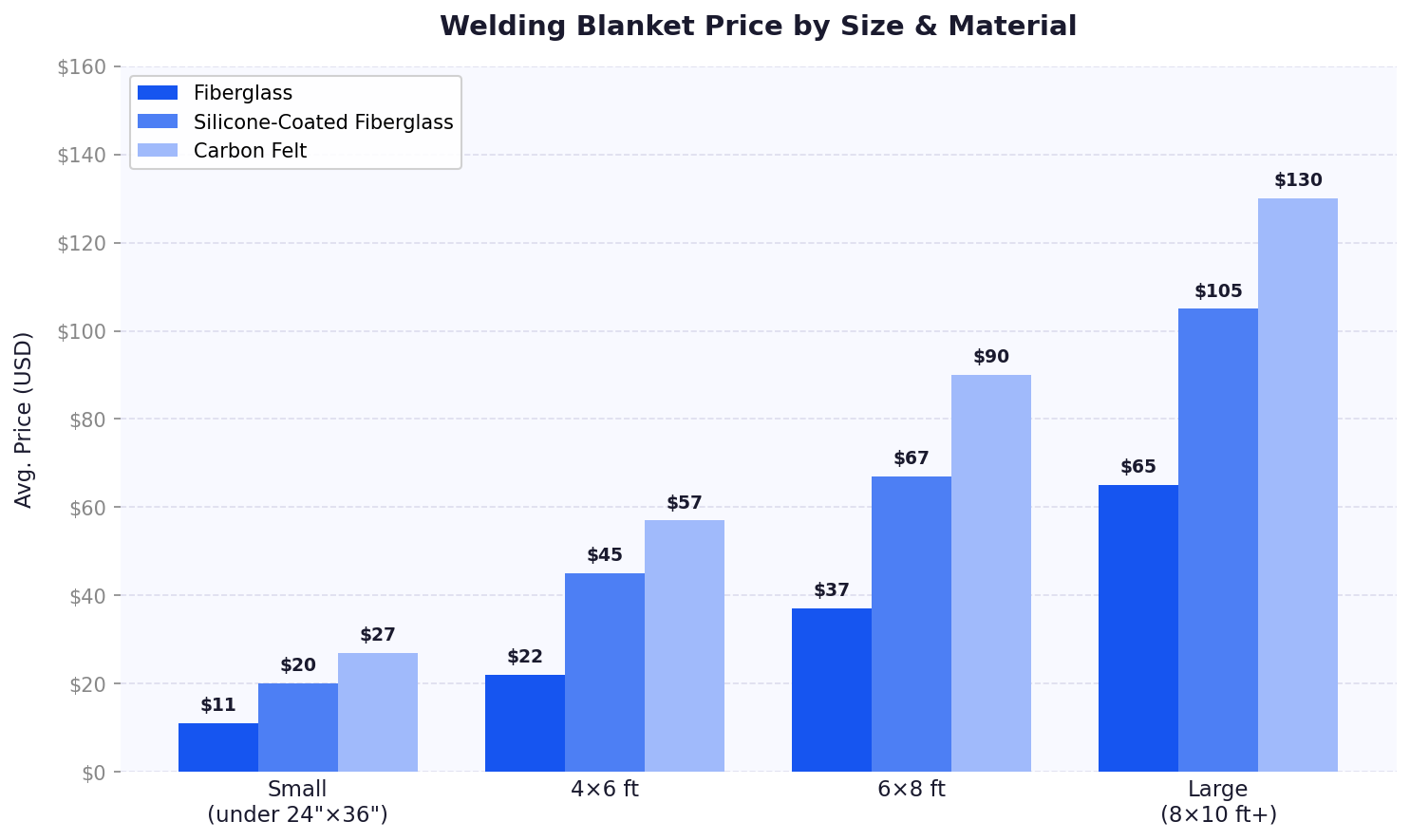
Same material, different size — the price difference can be significant. Here's a realistic breakdown using fiberglass and silicone-coated as reference points:
| Size | Fiberglass | Silicone-Coated Fiberglass | Carbon Felt |
|---|---|---|---|
| Small (under 24"×36") | $8 – $15 | $15 – $25 | $20 – $35 |
| 4×6 ft | $15 – $30 | $35 – $55 | $45 – $70 |
| 6×8 ft | $25 – $50 | $55 – $80 | $70 – $110 |
| Large (8×10 ft+) | $50 – $80 | $80 – $130 | $100 – $160+ |
Don't size up just to be safe — an oversized blanket is harder to position, more likely to catch on equipment, and costs more for no reason.
How to Choose the Right Size
- Small pads (under 24"×36"): Plumbing, HVAC torch work, tight spaces
- 4×6 ft: Most garage and shop welding jobs — the most popular size
- 6×8 ft: Larger fabrication work, vehicle frames, structural steel
- 8×10 ft+: Full area coverage, industrial floor protection, multi-welder setups
Quick rule: Your blanket should extend at least 12 inches beyond your work area on all sides. Sparks travel further than you think.
Where to Buy Welding Blankets at the Best Price
Knowing the price range is one thing — knowing where to actually get the best deal is another. Here's how the main buying channels compare.
Online Retailers
Amazon, Walmart.com, and specialist welding supply sites carry the widest selection. Price competition is high, and you'll often find 2-pack deals that bring the per-blanket cost down significantly.
- Widest material and size selection
- Easy price comparison across brands
- 2-pack and bulk deals common at entry and mid range
- Check seller ratings carefully — quality varies widely at lower price points
Local Welding Supply Stores
A local welding supply store lets you feel the weight and texture before buying — useful when you're choosing between materials for the first time. Prices are typically 10–20% higher than online, but you walk out with it the same day.
Tip: Search "welding blanket near me" or "welding supply store near me" — many local distributors stock silica and ceramic options that aren't easily available on Amazon.
Bulk & Industrial Purchasing
For contractors, site safety managers, or anyone outfitting a full crew, buying direct from a manufacturer or distributor unlocks meaningful price breaks.
- Orders of 10+ blankets often qualify for 15–25% discounts
- Custom sizes available at scale
- Consistent batch quality — important for compliance documentation
If you're buying more than 5 blankets at once, it's worth requesting a quote directly rather than paying retail.
Are Cheap Welding Blankets Worth It?
When a Budget Blanket Is Fine
A $20 fiberglass blanket is perfectly adequate for occasional home use. Welding a trailer hitch on a Saturday afternoon? Protecting a concrete floor from a few sparks? Entry-level blankets handle that without issue.
- Low-frequency use — a few times a month or less
- Light spark and spatter exposure
- No compliance or hot work permit requirements
When Cheap Costs You More
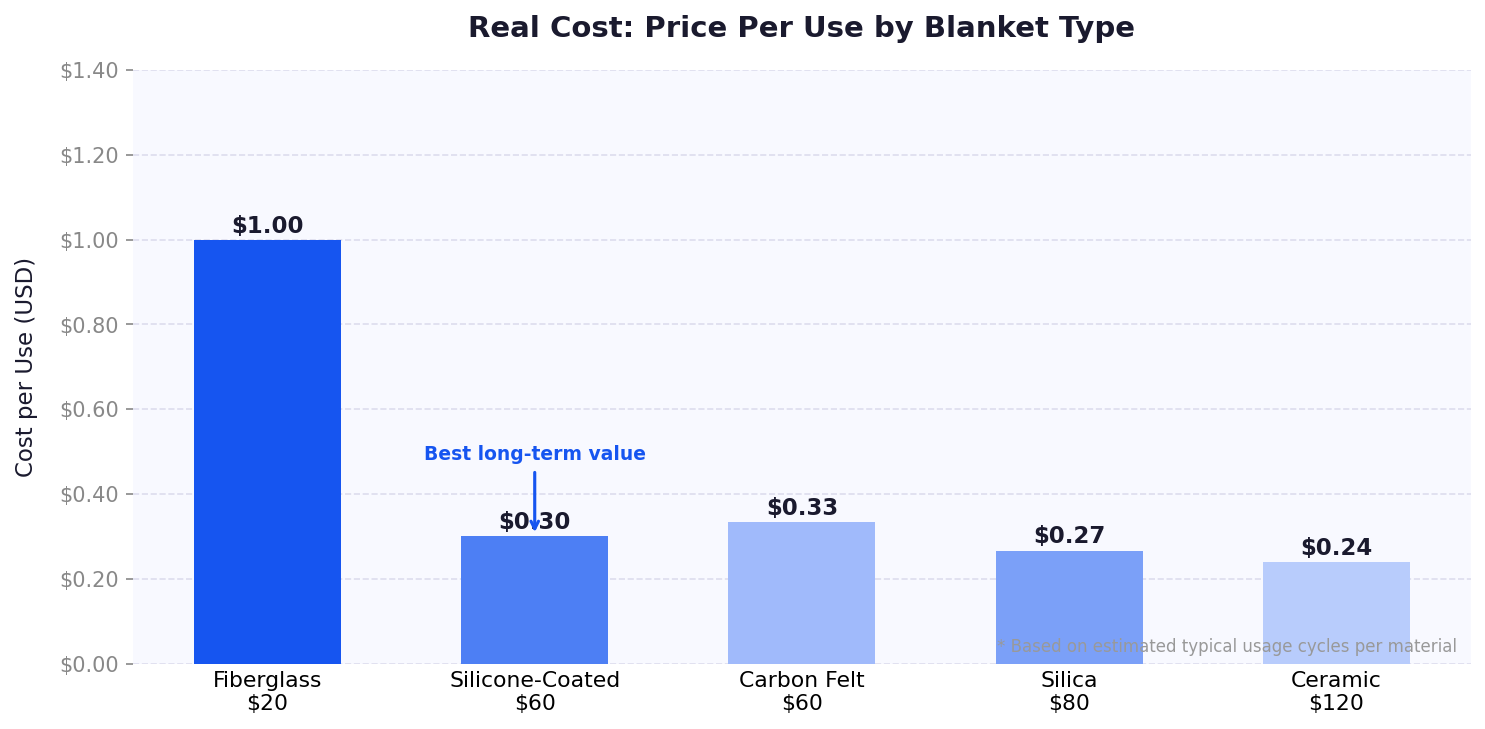
Run a $20 fiberglass blanket through a full week of heavy shop work and it starts to shed, fray, and lose thermal integrity fast. One blanket every three weeks at $20 is $350 a year. A $60 silicone-coated blanket lasting 18 months is less than half that cost.
Real cost check: Price per use matters more than sticker price. A blanket used 200 times at $60 costs $0.30 per use. One used 20 times at $20 costs $1.00 per use.
Red Flags to Watch For
- No temperature rating listed — a blanket without specs is a liability
- Very thin feel for the stated GSM — some listings overstate weight
- No grommets or poorly finished edges — blanket won't hang properly
- No brand or manufacturer contact — no recourse if it fails
FAQs About Welding Blanket Pricing
Still have questions? Here are the ones we hear most often.
How long do welding blankets last?
Entry-level fiberglass blankets typically last 6–12 months under regular shop use. Mid-range silicone-coated and carbon felt blankets often last 2–3 years. Heavy-duty silica and ceramic blankets can last 5+ years in industrial settings when stored properly.
Is a more expensive welding blanket always better?
Not always. Paying for higher temperature resistance you'll never need is wasted spend. Match the material to your actual working temperature and frequency — that's where the real value is.
Can welding blankets be reused?
Yes — all welding blankets are designed for repeated use. Inspect after each heavy job for charring, tears, or thinning. A blanket that's lost structural integrity in any area should be replaced, not patched.
Are fiberglass welding blankets safe?
They're safe in use, but the loose fibers can irritate skin and eyes during handling. Always wear gloves when folding or moving a fiberglass blanket. If skin sensitivity is a concern, carbon felt or silicone-coated options are significantly more comfortable to handle.
Conclusion
Welding blanket pricing comes down to one core principle: match the material to the job. A $20 fiberglass blanket is perfectly capable for occasional home use. A $90 silica or ceramic blanket is the right call when compliance, extreme heat, or daily heavy-duty use is on the table. Overspending on capability you don't need — or underspending on protection you do — both cost you in the long run.
If you're sourcing welding blankets for professional or industrial use, working with a reliable manufacturer makes a real difference in consistency, certification, and long-term value. LXHTR is a China-based manufacturer specializing in high-performance welding blankets across fiberglass, silicone-coated, carbon felt, silica, and ceramic fiber materials — built to meet the demands of contractors, fabrication shops, and industrial operations worldwide.
Ready to find the right blanket at the right price? Explore the full range at lx-htr.com or request a quote directly — bulk pricing and custom sizes are available.
0
Comments
Leave a Comment
Your email address will not be published. Required fields are marked *
Name can't be empty
Email error!
Message can't be empty
😍
😜
😳
😌
😄
😘
😝
😒
😃
😚
😚
😛
😟
😧
😀
😉
😓
😱
😤
😣
😂
😥
😩
😠
😢
😭
😰
😨
😡
😆
😪
😅
😐
😇
😋
😴
👿
😕
😏
😷
😵
😟
😮
😯
😑
👧
👴
😧
😬
😾
👶
👱
👵
👸
🙀
👺
👦
👩
👨
😽
😿
🙈
💩
💥
💤
😼
😹
🙉
🔥
✨
💦
👎
✌
👆
👈
💪
💹
👍
👊
💴
💶
💷
💸
👉
💵
🙏
🌎
🏧
👏
💳
👇
💑
🙆
🙅
💁
👫
👭
🙎
🙇
👑
👔
Submit Comment
Most Popular
-
 Jun 11, 2026Top 10 Fire Sleeve Manufacturers and Suppliers (2026 Review)
 -
 Jun 03, 2026What Is Ceramic Fiber? A High-Temperature Insulation Material Explained
 -
 Jun 08, 2026Top 10 Industrial Insulation Jacket Manufacturers Based in China 2026
 -
 May 07, 2026What Are Robot Covers? A Complete Guide to Robotic Protection Covers


Laster Blogs
-
 Jun 16, 2026Welding Blankets Price Guide: What to Expect & How to Get the Best Value
 -
 Jun 12, 2026Top 10 Robot Covers Manufacturers for Industrial Protection (2026)
 -
 Jun 11, 2026Top 10 Flange Guards Manufacturers: Which One Is Right for Your Industry?
 -
Jun 11, 2026Top 10 Fire Sleeve Manufacturers and Suppliers (2026 Review)


Set A Consultation Today
Name can't be empty
Email error!
Send Your Message
*We respect your confidentiality and all
information are protected.